
Lyophilized Peptide Reconstitution
Lyophilised — freeze-dried — peptides arrive as a solid because peptides are considerably more stable in the dry state than in solution. Reconstitution is the step that converts that stable solid into a working stock solution, and it is also the point at which most avoidable material loss occurs.
Errors at this stage are rarely dramatic. They show up later as inconsistent assay results, a stock that has quietly lost concentration, or material that never fully entered solution in the first place. The underlying causes are usually mundane: an unsuitable solvent for the sequence, condensation absorbed into a cold vial, a peptide adsorbed onto plasticware, or repeated freeze-thaw cycles.
This guide covers the reasoning behind each step of laboratory reconstitution, not just the sequence of actions.
Scope of This Guide
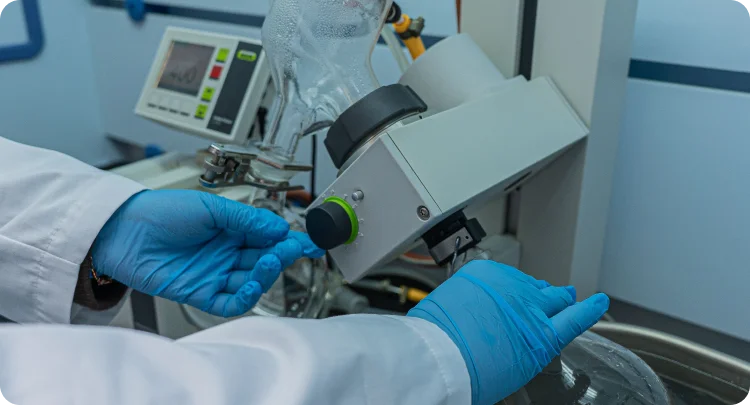
This article addresses preparation of peptide stock solutions for in-vitro and laboratory research applications — cell culture work, binding assays, analytical characterisation, and comparable bench procedures.
It does not address, and should not be read as addressing, preparation of material for administration to humans or animals. Research peptides are not evaluated or approved for such use, and questions about administration fall outside laboratory handling practice entirely. Where reconstitution guidance appears elsewhere framed around injection or dosing, that framing describes a different activity governed by a different regulatory context — not laboratory research.
Two consequences follow for the practical content below:
- Solvent selection here is driven by solubility and assay compatibility, not by parenteral formulation requirements.
- Concentration is expressed as stock solution concentrationfor experimental design (mg/mL or molarity), which is a bench calculation — not a dose.
Why Peptides Are Supplied Lyophilised
Lyophilisation removes water under vacuum from a frozen sample, leaving a solid cake or powder. The reason is stability: in aqueous solution, peptides are susceptible to chemical degradation pathways — hydrolysis, oxidation of susceptible residues such as methionine, cysteine, and tryptophan, and deamidation at asparagine and glutamine — and to microbial growth. Removing water substantially slows these processes.
The practical implication is that the dry state is the stable state. Once reconstituted, the material enters a less stable condition, which is why stock preparation, aliquoting, and storage planning are best treated as a single connected workflow rather than separate tasks.
The physical appearance of the lyophilised material varies. A fluffy cake, a compact pellet at the vial base, or a barely visible film are all normal presentations. Small quantities can be visually inconspicuous, and a vial that appears empty frequently is not — a common source of unnecessary concern.
Before Opening the Vial: Equilibrate to Room Temperature
Peptides are typically shipped and stored cold. Opening a cold vial in ambient air allows atmospheric moisture to condense onto the cold material, introducing water into a product whose stability depends on being dry.
The correct sequence is to allow the sealed vial to reach room temperature before opening. Depending on vial size and starting temperature, this typically takes on the order of tens of minutes; the operational rule is to wait until the exterior shows no condensation and the vial is no longer cold to the touch.
A second reason to equilibrate before opening: lyophilised material is light and easily disturbed. Briefly centrifuging the vial before opening brings any powder adhering to the cap or vial walls to the base, reducing loss when the seal is broken.
Selecting a Solvent
Solvent selection is the decision that most influences whether reconstitution succeeds, and it depends on the peptide’s own properties rather than on a universal default.
Charge-Based Solubility Reasoning
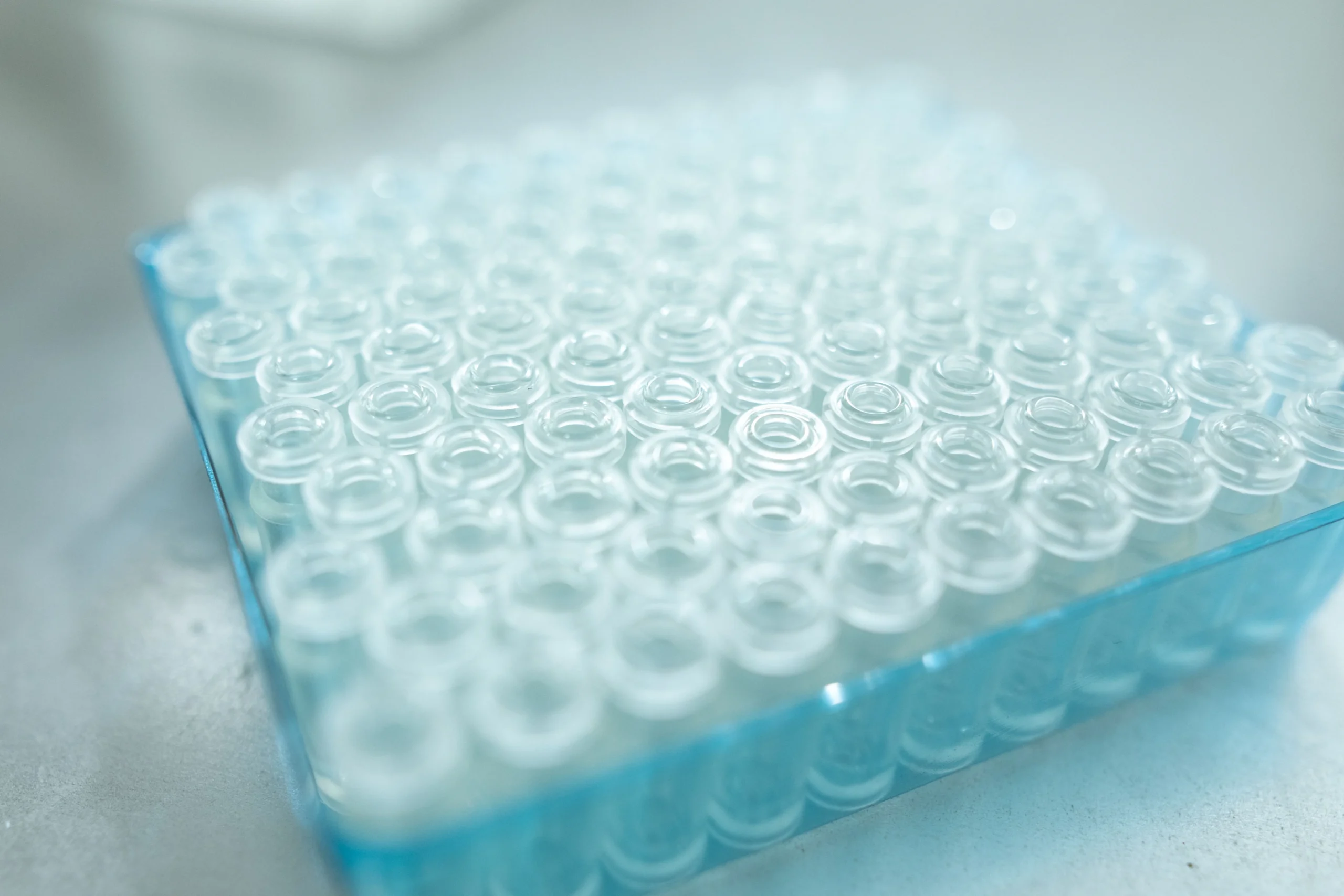
A useful first-pass approach is to consider the net charge of the sequence at neutral pH, based on the residues present:
| Sequence character | Typical first-choice approach |
|---|---|
| Net positive (basic) — excess of Arg, Lys, His | Sterile distilled water is often a reasonable starting point; dilute acetic acid may assist where water alone is insufficient |
| Net negative (acidic) — excess of Asp, Glu | Water is often a reasonable starting point; a dilute base such as ammonium bicarbonate may assist where needed |
| Near-neutral or hydrophobic — high proportion of nonpolar residues | Frequently requires a small volume of an organic co-solvent (commonly DMSO or acetonitrile) to achieve initial dissolution, followed by dilution into aqueous buffer |
| Contains cysteine | Requires additional care: free thiols are oxidation-prone, and disulfide formation can occur in solution |
This is a starting framework, not a rule that resolves every case. Sequence-specific behaviour, secondary structure, and aggregation tendency all influence real solubility, and the manufacturer’s stated solubility information for the specific compound should take precedence where it is provided.
A Note on Solvent Terminology
Preparations described as “bacteriostatic” are formulated for multi-dose parenteral pharmaceutical products and carry a preservative for that purpose. That formulation context belongs to human medical products, not to laboratory research materials, and such preparations are not a requirement for in-vitro work. For laboratory stock preparation, solvent selection should be based on solubility and assay compatibility as described above.
Selecting a Solvent
A step frequently omitted: where the solubility behaviour of a compound is uncertain, test on a small portion before adding solvent to the whole vial.
The reasoning is straightforward — once an unsuitable solvent has been added to the entire quantity, the decision cannot be reversed, and recovering the material means lyophilising it again. Testing a small aliquot first preserves the option of a different approach.
Where the manufacturer provides solubility information for the compound, that information reduces the need for empirical testing. Where it does not, a small-scale test is the lower-risk path.
Calculating Stock Concentration
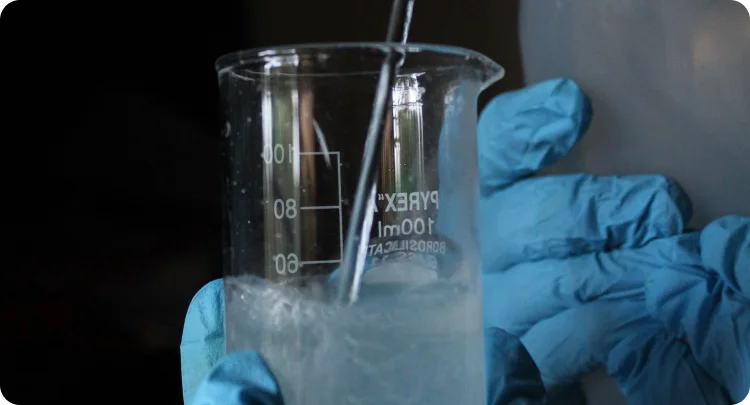
Stock concentration is a bench calculation used to design experiments. Two relationships cover most cases.
Mass concentration
Concentration (mg/mL) = mass of peptide (mg) ÷ solvent volume (mL)
Molar concentration
Molarity (mM) = [mass (mg) ÷ molecular weight (g/mol)] ÷ volume (L) × 1000
Two adjustments are commonly overlooked:
- Use peptide content, not vial mass, for accurate molarity.Lyophilised powder includes water and counter-ions in addition to peptide. Where the certificate of analysis reports peptide content, that figure gives the actual peptide mass; where it does not, calculations based on nominal vial mass will overstate concentration to an unknown degree.
- Use the correct molecular weight basis.The peptide’s molecular weight and the salt-form mass differ. Confirm which basis the documentation reports before calculating.
For quantitative work, these two corrections are the difference between a nominal concentration and an accurate one.
The Reconstitution Procedure
With solvent selected and concentration determined:
- Equilibrate the sealed vial to room temperature.Confirm no condensation remains on the exterior.
- Centrifuge briefly to collect material at the vial base before opening.
- Add solvent slowly, directed down the vial wall rather than injected directly onto the peptide cake. Forceful addition onto the solid promotes localised aggregation and foaming.
- Allow the solvent to contact the material undisturbed for a short period before any mixing. Many peptides begin dissolving without agitation.
- Mix gently — slow swirling or gentle inversion. Avoid vigorous shaking and avoid vortexing where it can be avoided; mechanical stress and the resulting air-liquid interface promote aggregation and denaturation, and foaming both traps material and complicates volume accuracy.
- Assess dissolution visually. A properly reconstituted solution is normally clear and free of visible particulates. Cloudiness, visible solids, or a persistent film indicate incomplete dissolution.
- Sonicate only if required, briefly, and with attention to heating. Sonication is a troubleshooting measure, not a routine step.
- Aliquot immediately — see below.
Aliquoting: The Step That Preserves the Stock
Aliquoting the reconstituted stock into single-use volumes before freezing is, for most workflows, more consequential than the choice of storage temperature.
Freeze-thaw cycling.
Each freeze-thaw cycle exposes the peptide to concentration and pH changes at the ice interface and to mechanical stress. Repeated cycling is a recognised contributor to peptide degradation and aggregation. A single stock tube thawed repeatedly accumulates this damage; single-use aliquots each undergo one cycle.
Adsorptive loss
Peptides — particularly hydrophobic sequences and those present at low concentration — adsorb onto container surfaces. The proportional loss is greatest in dilute solutions, where a fixed quantity of adsorbed material represents a larger share of the total. Low-binding tubes and appropriate container selection reduce this. Preparing dilute working solutions immediately before use, rather than storing them, avoids extended surface contact.
A Note on Solvent Terminology
- Size aliquots to the working volume actually used, so no tube is opened twice.
- Label each with compound, concentration, solvent, and preparation date. An unlabelled aliquot is an unusable aliquot within weeks.
- Minimise the interval between reconstitution and freezing.
- Record the preparation details alongside the batch number from the certificate of analysis, so the stock remains traceable to its source material.
Stability of Reconstituted Stock
Solution-phase stability is compound-specific and cannot be reduced to a single universal figure. What can be stated as general principle:
- Solution is less stable than the lyophilised state.Reconstituted material has a shorter usable life than the dry powder by a considerable margin.
- Lower temperature slows degradation.Storage temperature choice reflects this, with colder conditions generally used for longer intervals.
- Repeated warming and cooling is more damaging than the storage temperature alone, which is why aliquoting matters.
- Certain residues are more vulnerable in solution— methionine, cysteine, and tryptophan to oxidation; asparagine and glutamine to deamidation. Sequences containing these warrant more conservative handling.
- pH influences degradation rate, so buffer selection is a stability decision as well as an assay decision.
Where the manufacturer publishes stability or storage information for a specific compound, that compound-specific guidance should take precedence over general principles. Where extended storage is planned and no such data exists, stability should be established empirically for the conditions in use rather than assumed.
Troubleshooting Reconstitution Problems
| Observation | Likely explanation | Reasonable response |
|---|---|---|
| Solid remains undissolved after gentle mixing | Solvent unsuited to the sequence's charge or hydrophobicity | Reassess solvent choice against sequence character; consider a co-solvent approach |
| Solution appears cloudy or opalescent | Incomplete dissolution or aggregation | Allow additional undisturbed time; brief sonication; reassess solvent if unresolved |
| Visible particulates persist | Aggregation, or insoluble material at the concentration attempted | Consider a lower stock concentration; reassess solvent system |
| Foaming during mixing | Excessive agitation; air-liquid interface stress | Switch to slow swirling or inversion; allow foam to settle before volume measurement |
| Vial appears empty | Small quantity present as a thin, visually inconspicuous film | Centrifuge before opening; proceed normally |
| Measured concentration lower than calculated | Peptide content not accounted for; adsorptive loss; incomplete dissolution | Recalculate using peptide content from the COA; consider low-binding containers |
| Solution clear initially, turbid after storage | Aggregation over time, or freeze-thaw effects | Review aliquoting practice and storage conditions; prepare fresh stock |
| Gradual loss of activity across experiments | Freeze-thaw cycling, degradation, or adsorption | Use single-use aliquots; reduce storage interval; verify container compatibility |
Terminology
| Term | Meaning |
|---|---|
| Lyophilisation | Freeze-drying; removal of water by sublimation under vacuum from a frozen sample |
| Reconstitution | Returning a lyophilised solid to solution by adding a suitable solvent |
| Stock solution | A concentrated prepared solution from which working dilutions are made |
| Working solution | The diluted solution at the concentration used in the experiment |
| Aliquot | A measured portion divided from a larger volume, typically for single use |
| Peptide content | The proportion of the lyophilised powder that is peptide, excluding water and counter-ions |
| Counter-ion | The salt form associated with the peptide, commonly acetate or trifluoroacetate |
| Adsorption | Adherence of peptide to container surfaces, reducing solution concentration |
| Freeze-thaw cycle | One complete cycle of freezing and thawing, each contributing cumulative stress |
| Co-solvent | A secondary solvent, often organic, used to achieve initial dissolution before aqueous dilution |
Frequently Asked Research Questions
What does reconstituting a lyophilized peptide mean?
Reconstitution is the process of returning a freeze-dried peptide to solution by adding a suitable solvent. Peptides are supplied lyophilised because the dry state is substantially more stable than solution; reconstitution converts the material into a stock solution for laboratory use.
Which solvent should be used to reconstitute a lyophilized peptide?
Solvent choice depends on the peptide’s sequence and on downstream assay compatibility. Sequences with net positive or negative charge at neutral pH often dissolve in sterile distilled water, while hydrophobic sequences frequently require a small volume of an organic co-solvent before dilution into aqueous buffer. Manufacturer-provided solubility information for the specific compound takes precedence over general rules.
Why should a peptide vial reach room temperature before opening?
Opening a cold vial allows atmospheric moisture to condense onto the cold contents, introducing water into a material whose stability depends on remaining dry. Allowing the sealed vial to equilibrate first avoids this.
Why should reconstituted peptide be aliquoted?
Each freeze-thaw cycle contributes cumulative stress that can promote degradation and aggregation. Dividing the stock into single-use aliquots means each portion undergoes one cycle rather than many, which for most workflows preserves the material more effectively than storage temperature alone.
Why is a reconstituted peptide solution cloudy?
Cloudiness generally indicates incomplete dissolution or aggregation. Allowing additional undisturbed time, gentle mixing, or brief sonication may resolve it. Persistent turbidity usually indicates that the solvent system is unsuited to the sequence or that the attempted concentration exceeds practical solubility.
Should peptide solutions be vortexed?
Vigorous agitation is generally avoided where possible. Mechanical stress and the air-liquid interface created by shaking or vortexing promote aggregation and denaturation, and foaming both traps material and reduces volume accuracy. Slow swirling or gentle inversion is the usual approach.
Does the certificate of analysis affect concentration calculations?
Yes. Lyophilised powder contains water and counter-ions in addition to peptide, so the vial mass overstates peptide mass. Where the COA reports peptide content, that figure should be used for accurate molarity calculations; calculations based on nominal vial mass will overstate concentration by an unknown margin.
How long is a reconstituted peptide stock usable?
Solution-phase stability is compound-specific and depends on sequence, solvent, pH, and storage conditions. Reconstituted material is consistently less stable than the lyophilised form. Where the manufacturer publishes compound-specific stability information, that guidance applies; otherwise stability should be established empirically for the conditions in use rather than assumed.
Reviewing Compound Documentation
Sound reconstitution practice depends on knowing the material: its sequence and charge character, its molecular weight basis, its counter-ion, and — for accurate concentration work — its peptide content.
Researchers can review the published specifications and batch documentation for individual compounds in the Everclear Peptides research catalogue, or contact the research support team with documentation questions relating to a specific lot.